
Criminal Court Records in Bolivar County
A criminal court record opens the day charges are filed. It is not the arrest report and it is not the jail booking sheet. It is the case file the court clerk builds and keeps as the matter moves through the system. The file grows with each motion, order, hearing, and ruling. By the time a case closes, the record shows who was charged, what was charged, how the defendant answered, and what the court decided.
The clerk of court is the custodian of these files. In Bolivar County, Circuit Clerk Judith D. Thompson serves as clerk of the Circuit, County, and Youth Courts. Because the county has two judicial districts, that office acts as the records arm for six courts in all. The clerk files lawsuits, indictments, and motions, issues process, and keeps the judgments and executions that close a case.
Court level depends on the charge. Felony prosecutions go to Circuit Court as part of the Eleventh Circuit Court District. Lower offenses split across the County, Justice, and Municipal Courts. A traffic charge or a city ordinance violation may sit in Justice Court or a city Municipal Court, while many misdemeanors and youth matters route through County Court. The arrest side of the story and the charges themselves are covered on the Bolivar County arrest records and court charges page.
How to Search Bolivar County Criminal Court Records
There is no single county portal that opens every criminal case in one search. The path is venue first, then district, then the right tool. Felony files point to Circuit Court. The two districts sit at 801 Main Street in Rosedale and 200 South Court Street in Cleveland. Once you know the court and the district, you can pick between the online system and the clerk counter.
Mississippi Electronic Courts, known as MEC, is the statewide filing and case-management system for Chancery, Circuit, and County Courts. Public Access to MEC, called PAMEC, is the public path, but it is account based and needs a login. The Eleventh Circuit MEC court-information page shows court locations and case flags without a login, yet it does not expose a free open search form.
- Confirm the court level. Use Circuit Court for felonies and County, Justice, or Municipal Court for lower offenses.
- Pick the judicial district. Decide whether the case belongs to the First District in Rosedale or the Second District in Cleveland.
- Register for PAMEC if you need the online docket. Search by defendant name or case number, then narrow by court, case type, and date.
- Open the case to read the docket entries, the disposition, and the sentence.
- Request a certified copy from the Circuit Clerk in the correct district when you need a court-ready document.
When online access falls short, the clerk counter is the fallback. Call or visit the Circuit Clerk in the proper district. Ask whether the case is in MEC, whether documents can be viewed at the counter, and what copy or certification fees apply. The First District clerk line is 662-759-6521 in Rosedale, and the Second District clerk line is 662-843-2061 in Cleveland. Older, sealed-status, or non-digitized files almost always need a written public-records request to the clerk who holds the file.
Stages of a Bolivar County Criminal Case
A criminal case moves through set stages, and each one leaves a mark in the record. Knowing the stages helps a reader place a docket entry in time. The record shows when charges came in, when the defendant first answered, what motions were argued, and how the case ended. A felony case in Circuit Court usually starts with a grand-jury indictment, while lower courts may proceed on a complaint or affidavit.
Case flow: Charges Filed › Arraignment › Pretrial / Motions › Plea or Trial › Disposition › Sentencing
| Stage | What Happens |
|---|---|
| Charges Filed | The prosecutor files an indictment, information, or affidavit. The clerk opens the case and assigns a number. |
| Arraignment | The charges are read in open court and the defendant enters a plea. Bond terms may be set or changed here. |
| Pretrial / Motions | Both sides file motions, exchange evidence, and argue legal questions. Hearings and continuances are logged. |
| Plea or Trial | The case ends in a negotiated plea or goes to a judge or jury for a verdict. |
| Disposition | The record states the result of each charge, such as guilty, not guilty, dismissed, or nolle prosequi. |
| Sentencing | After a conviction, the court orders the penalty and notes any probation, restitution, or fines. |
Note: A single case file can carry several charges at once, and each charge can reach a different disposition, so read the record charge by charge.
What a Bolivar County Criminal Court Record Shows
The case file is built from many small fields. Read together, they tell the whole story of the prosecution. The docket lists every filing and event in order, from the first charge to the final order. The financial section tracks fines, court costs, restitution, bonds, and assessments. The status field flags where the case stands today.
| Field | What It Shows |
|---|---|
| Case Number | The unique number the filing court and MEC assign when the case opens. |
| Court and District | Whether the matter is in Circuit, County, Justice, or Municipal Court, and the First or Second District. |
| Defendant | The accused person named in the charging document. |
| Charges | The offenses filed, with code sections and severity, as written and as later amended. |
| Judge | The Circuit judge or county judge assigned to hear the case. |
| Plea | The defendant's formal answer, such as guilty, not guilty, or no contest. |
| Docket Entries | Filings, motions, orders, hearings, continuances, warrants, and bonds in date order. |
| Disposition | The outcome of each charge once the court rules or the plea is entered. |
| Sentence | The penalty ordered after a conviction, with any probation or supervision terms. |
| Status | Open, closed, sealed, expunged, probation, or one of the pending court flags. |
Three Bolivar County Eleventh Circuit judges sign these orders: Linda F. Coleman, W. Hunter Nowell, and Charles E. Webster. The full set of Bolivar County court records spans civil, family, and probate files, while the criminal case file itself tracks charges, pleas, disposition, and sentencing.
Who Prosecutes Criminal Cases in Bolivar County
The state, not the victim, brings a criminal charge. In felony cases that work falls to the District Attorney. Brenda F. Mitchell serves as District Attorney for the Eleventh Circuit Court District, which covers Bolivar, Coahoma, Quitman, and Tunica counties. Her office represents the State before the grand jury and carries the felony docket through Circuit Court. The county office sits at P.O. Box 848 in Cleveland and can be reached at 662-843-8000.
The county's District Attorney page lists the office contact and notes that a county or municipal prosecutor may be designated to appear for the district attorney under a filed agreement.
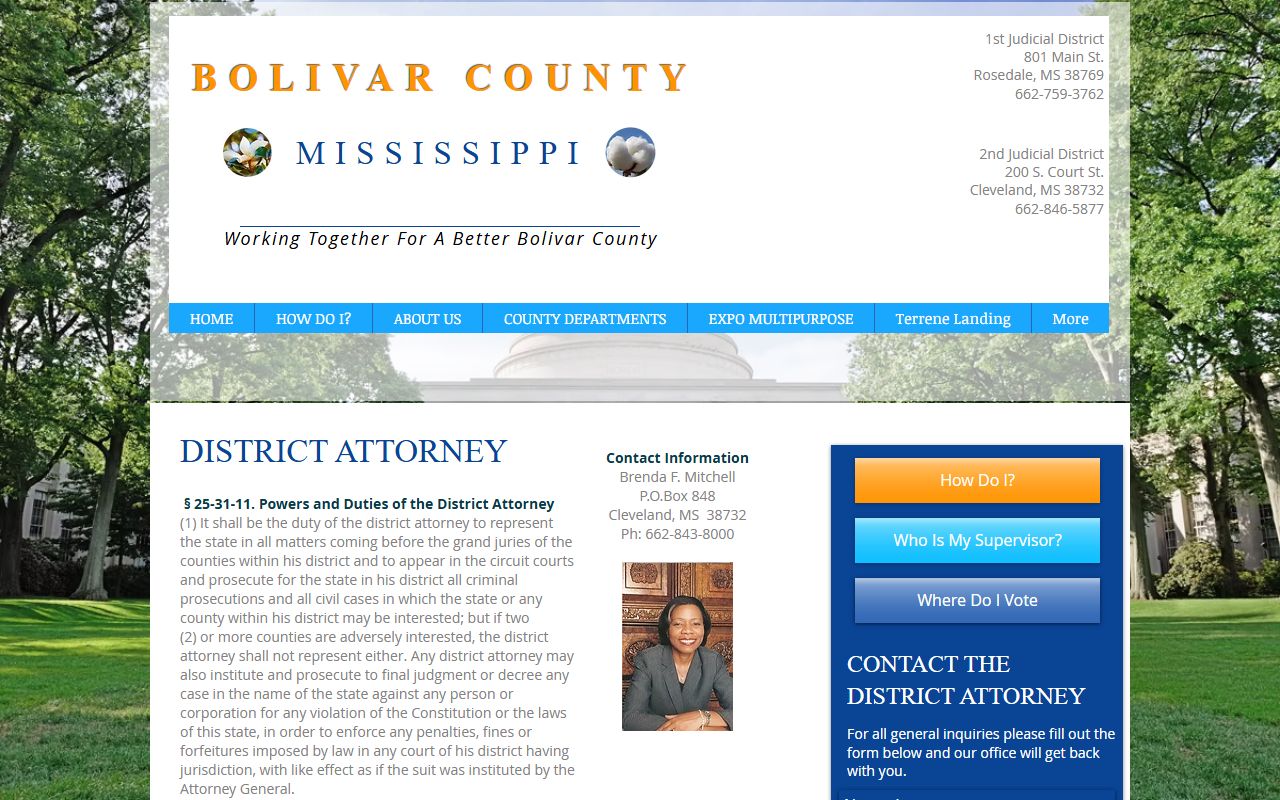
That page is the starting point for confirming who handles a felony before it reaches a Circuit Court file.
The District Attorney also keeps a separate Eleventh Circuit site with office details for all four counties in the district.
The Eleventh Circuit District Attorney site explains the office's duty to seek justice and to represent the State across the district.
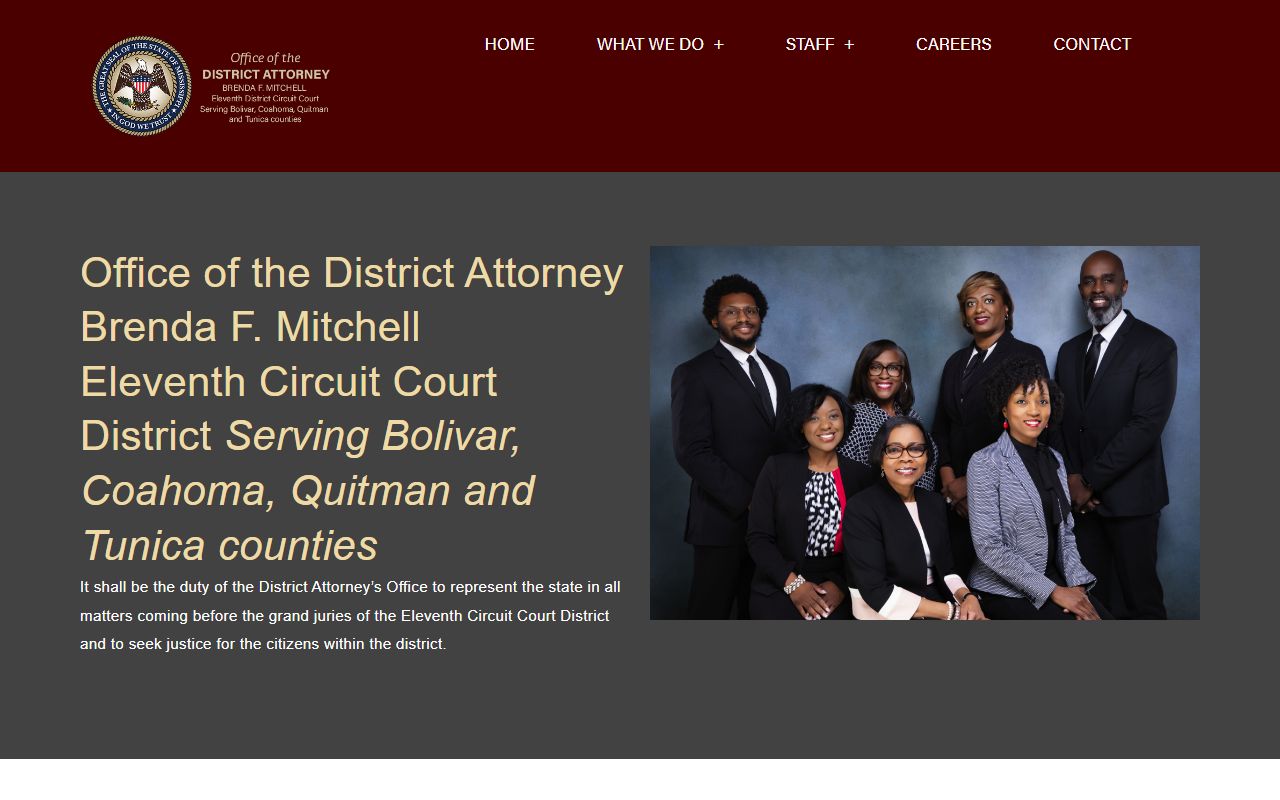
That site helps a reader tie a Bolivar County felony file to the prosecutor pursuing it.
Lower offenses follow a different track. The county prosecuting attorney holds full responsibility for misdemeanors, youth-court proceedings, and cases not granted to the district attorney, and may assist the district attorney where the state, county, or a city has an interest. If a county-prosecutor case is changed so it falls within district-attorney jurisdiction, the file transfers to the district attorney.
The county's County Attorney page sets out those duties and the transfer rule.
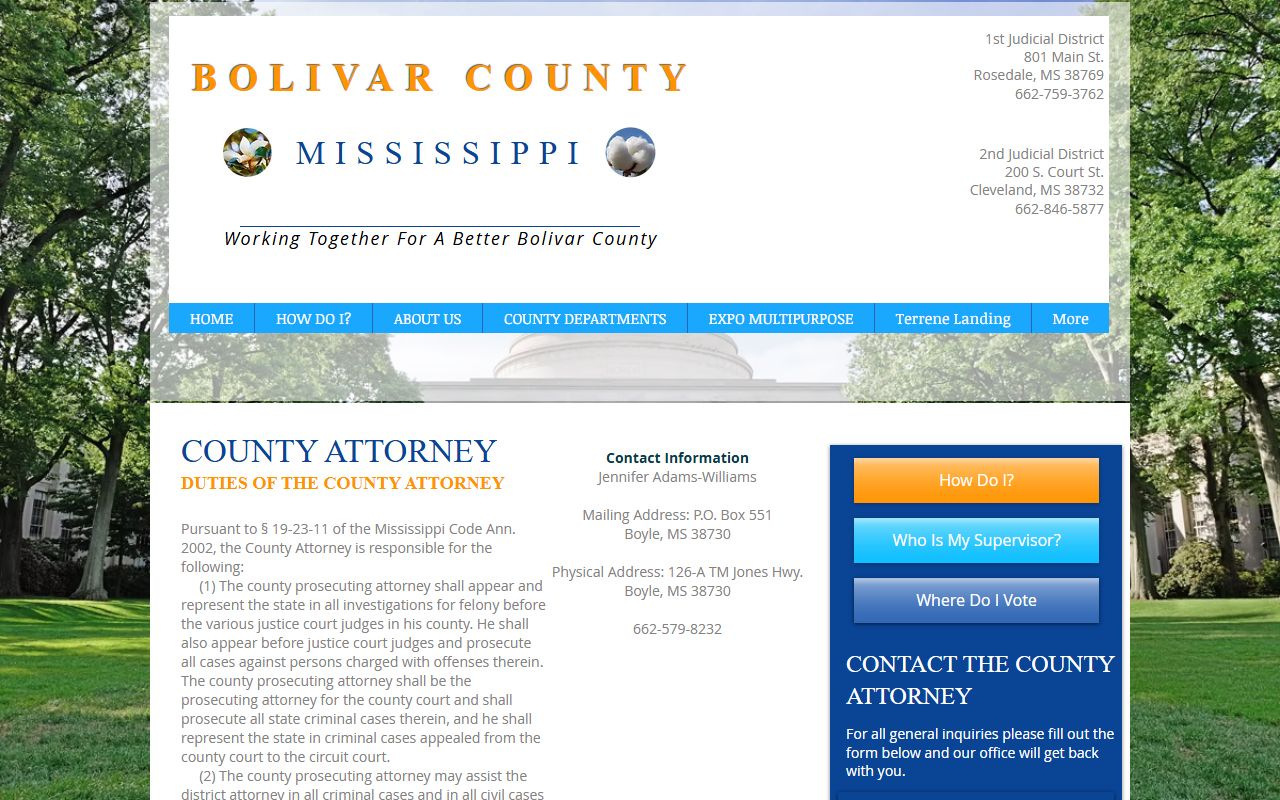
That page clarifies which office to call when a case is a misdemeanor rather than a felony.
Charges vs. Convictions
A charge and a conviction are not the same thing. A charge is an accusation. A conviction is a final finding of guilt by plea or verdict. A criminal court record can show charges that were later dropped, dismissed, or ended in acquittal. Reading only the charge and stopping there gives a false picture of how a case turned out.
| Charge | Conviction | |
|---|---|---|
| Stage | Accusation filed by the state | Guilty verdict or guilty plea |
| Burden of Proof | Probable cause | Beyond a reasonable doubt |
| Can Change? | May be amended, reduced, or dismissed | Final unless reversed on appeal |
| Public Record | Yes, unless restricted | Yes, unless expunged |
Because the two can drift apart as a case moves, always read the disposition for each charge. A nolle prosequi flag means the prosecutor chose not to go forward. A dismissal means the court ended the charge. Only a conviction reflects guilt that the court has entered.
Reading Dispositions and Sentences
The disposition is the heart of a criminal court record. It states how each charge ended. Common results include guilty, not guilty, dismissed, acquitted, and nolle prosequi. A no-contest, or nolo, plea accepts the penalty without admitting the facts. After a guilty result, the sentence section lists the penalty, which may mix jail or prison time, probation, fines, restitution, and court costs.
Bolivar County case files in MEC carry status flags that tell you where a case stands at a glance. These flags appear on the public Eleventh Circuit court-information page. Reading them saves a trip to the counter.
- Arraignment Pending: the first hearing and plea have not happened yet.
- Bench Warrant Issued: a judge has ordered the defendant taken into custody, often after a missed date.
- Capias Pending: a capias, a warrant-like order to bring a person in, is outstanding.
- Plea Pending: a plea has not yet been entered or completed.
- Nolle Pros Pending: the prosecutor has moved to drop the charge.
- Probation: the defendant is under court-ordered supervision.
A bench warrant or a capias flag means the case is active and someone is wanted. Those entries connect to the Bolivar County warrant records page, which explains how to check for and clear an outstanding warrant.
Sealed vs. Expunged Criminal Records
Two court actions can pull a criminal record out of public view, and they are not the same. A sealed record still exists but is hidden from general public access. An expunged record is treated in law as if it never happened. MEC uses both an EXPUNGED flag and a SEALED flag to mark these cases. Once either order applies, public access changes and the case should not read like an ordinary open conviction.
| Sealed | Expunged | |
|---|---|---|
| Visibility | Hidden from public view | Treated as if it never existed |
| Law Enforcement | Limited access by court order | Very limited access |
| How It Starts | Court order or statute | Petition granted under Miss. Code Section 99-19-71 |
| Eligibility | Set by the judge or by law for the file type | One conviction, five years after the sentence is fully served |
The Eleventh Circuit District Attorney publishes an expungement resource that walks through who qualifies. Mississippi law allows one conviction to be expunged from public records five years after a person completes every term of the sentence, subject to disqualifying offense categories. Dismissed cases, dropped charges, and acquittals may follow different eligibility paths.
The Delta District Attorney expungement page lays out the Section 99-19-71 conditions in plain terms.
That resource helps a reader judge whether an old conviction may qualify before filing in the court that handled the case.
Public Access to Bolivar County Criminal Records
The default rule in Mississippi is open access. Criminal court records are public unless a statute, court rule, or judge's order restricts them. The correct custodian still matters, since Circuit and County files come from the Circuit Clerk while other matters sit with their own courts. Fees may apply for searching, copying, and mailing records.
Key Statutes:
Miss. Code Title 25, Chapter 61 - the Mississippi Public Records Act makes records of public bodies open to inspection unless a valid exemption applies.
Miss. Code Section 25-61-11 - records made confidential by law, court order, or privilege stay closed even after a request is made.
Miss. Code Section 99-19-71 - sets the conditions under which eligible Mississippi convictions and non-conviction outcomes may be expunged.
When a file is older, certified, or non-digitized, a written request to the right clerk is the surest route. The Mississippi Public Records Act covers public bodies in general, but court case files are usually requested from the clerk that holds them.
Appointed Counsel and Public Defenders
The right to a lawyer runs through a criminal case, and the record often shows who that lawyer is. When a defendant cannot afford counsel, the court appoints one. In Bolivar County, appointment for state criminal cases is handled through the court process, so a defendant or family member should ask the court where the case is pending. No standalone Bolivar County public-defender office page was located in official sources.
The Mississippi Office of State Public Defender keeps directories and training resources for defense counsel across the state.
The Office of State Public Defender directory is the place to look up defender contacts by area.
That directory helps connect a defendant to the right defense office while a case is open.
For broader background on indigent defense and training, the state office keeps a main hub.
The Office of State Public Defender home page explains the office's role in defender training and support.
That hub rounds out the picture of how defense counsel is arranged in state cases. Eligible defendants who want a treatment track can also reach the Eleventh Circuit Drug Court coordinator, Angie Kent, at 662-846-2944.
Background Check Considerations
People often read criminal court records to vet a name. A casual lookup is fine for personal knowledge. A formal background check used for hiring, housing, credit, or insurance is governed by the Fair Credit Reporting Act and must run through a compliant consumer reporting agency. Court files can be incomplete or out of date, so a single docket entry is not proof of a current legal status.
Important: This site is not a consumer reporting agency under the FCRA, and its content cannot be used for credit, employment, tenant, or insurance screening.
Restricted Criminal Court Records in Bolivar County
Not every criminal matter is open. Several categories are closed by law or by court order. Youth Court files are confidential in many situations, and the County Court judge also serves as the Youth Court judge. Juvenile law-enforcement records made and kept for children are confidential except as the law allows. Expunged and sealed cases carry their own MEC flags and should not be treated as ordinary public convictions.
Public copies may also redact sensitive details. Social Security numbers, financial account numbers, minor information, and protected addresses are commonly removed before release. When a case is sealed or a charge is expunged, the court order controls what a clerk may disclose. The safest course is to ask the clerk for the district that holds the file whether a record is open, restricted, or off limits.