
Bolivar County Arrest Records and Court Charges
An arrest record marks the moment a person is taken into custody. It notes the arresting agency, the date, and the booking. In Bolivar County, many arrests run through Sheriff Kelvin Williams Sr. and the Regional Correctional Facility, or through a city police force such as Cleveland or Rosedale. That booking record sits with the jail or the agency that made the arrest. It is the custody side of the case, not the court file.
The court charges come next. Once someone is arrested, a prosecutor reviews the facts and decides what to file. The District Attorney handles felonies, while the county prosecuting attorney handles most misdemeanors. The charges they file with the court clerk become the charge record, and that record is tracked through the case. For the jail roster and booking detail, the Bolivar County inmate records page covers the custody side. For the full case file and final outcome, see the criminal court records page.
So the arrest-to-charges pathway has two clear halves. One half is the arrest itself, held by the Sheriff or the city police. The other half is the set of court charges after arrest, held by the court clerk. Reading both gives the true status of a case.
How to Find Bolivar County Arrest Records and Charges
There is no single county portal that opens every arrest and every charge at once. The charge side lives in the court case file. The arrest and booking side lives with the jail or the arresting agency. The path is to pick the right court level, then the right judicial district, then the right tool. Felony charges point to Circuit Court in the Eleventh Circuit Court District. Lower charges split across the County, Justice, and Municipal Courts.
Mississippi Electronic Courts, known as MEC, is the statewide filing and case-management system for Chancery, Circuit, and County Courts. The public path is called Public Access to MEC, or PAMEC, and it needs an account and a login. The Eleventh Circuit MEC court-information page shows court locations and case flags without a login, but it does not expose a free open search form.
- Confirm the court level. Use Circuit Court for felony charges and County, Justice, or Municipal Court for lower offenses.
- Pick the judicial district. Decide whether the case sits with the First District in Rosedale or the Second District in Cleveland.
- Open the case in PAMEC by defendant name or case number, or call the Circuit Clerk in the right district.
- Read the charge list, then check each charge for its code, level, and current status.
The arrest and booking record is a separate request. For current local custody, the official channels are the Sheriff's Department at 662-843-5378 and the Regional Correctional Facility at 662-843-7478. The jail roster and booking detail are covered on the inmate records page. When an online charge search falls short, a written public-records request to the clerk that holds the file is the fallback, and the Mississippi Public Records Act sets out how those requests work.
How Bolivar County Charges Get Filed After an Arrest
The charge record begins when a prosecutor files a charging document. The arrest happens first, at booking. Then the state decides what to file and in which court. Brenda F. Mitchell serves as District Attorney for the Eleventh Circuit Court District, which covers Bolivar, Coahoma, Quitman, and Tunica counties. Her office takes felony matters to the grand jury and carries the felony charges through Circuit Court. The county prosecuting attorney holds misdemeanors, youth-court work, and cases not granted to the district attorney. Three main charging documents start a case, and the type signals how serious the charges are.
| Complaint | Information | Indictment | |
|---|---|---|---|
| Filed By | Officer or prosecutor | Prosecutor | Grand jury |
| Common For | Misdemeanors | Some felonies | Felonies in Circuit Court |
| Court | Justice or Municipal | County or Circuit | Circuit Court |
| Starts | The case | The case | The case |
In Bolivar County, the most serious charges reach Circuit Court by way of a grand-jury indictment. The Eleventh Circuit District Attorney site explains the office's duty to present matters to the grand jury and to seek justice across the district. A misdemeanor, by contrast, often moves on a complaint or affidavit in Justice or Municipal Court without a grand jury.
Bolivar County Charge Status and What It Means
Charges do not stand still. As a case moves, a charge can be amended, reduced, added, dropped, or dismissed. The court record tracks each shift, and MEC marks it with status flags on the public court-information page. Reading the status for each charge tells you where the case stands today, not just where it started.
| Status | What It Means |
|---|---|
| Filed | The prosecutor has filed the charge and the clerk has opened the case. |
| Pending | The charge is active and the case is still moving, with no final outcome yet. |
| Amended / Reduced | The prosecutor has changed the charge, often to a lesser offense. |
| Dismissed | The court has ended the charge, and it will not move forward. |
| Nolle Prosequi | The prosecutor has chosen not to pursue the charge. |
| Bound Over | A lower-court matter has been sent up to a higher court for further action. |
Note: A single arrest can lead to several charges, and each charge can reach a different status, so read the case file charge by charge rather than as one block.
Charges vs. Convictions
Being charged is not the same as being convicted. A charge is an accusation. A conviction is a final finding of guilt by plea or by verdict. A charge record can show charges that were later dropped, reduced, or dismissed. Stopping at the charge and skipping the outcome paints a false picture of how a case turned out.
| Charge | Conviction | |
|---|---|---|
| Stage | Accusation filed by the state | Guilty plea or guilty verdict |
| Burden of Proof | Probable cause | Beyond a reasonable doubt |
| Can Change? | May be amended, reduced, or dismissed | Final unless reversed on appeal |
| Public Record | Yes, unless restricted | Yes, unless expunged |
Because the charge and the result can drift apart, the disposition matters most. A dismissal means the court ended the charge. A nolle prosequi flag means the prosecutor chose not to go forward. Only a conviction reflects guilt the court has entered. The Bolivar County criminal court records page walks through the full case file, the disposition, and the sentence.
Sealed vs. Expunged Records
Two court actions can pull a charge record out of public view, and they work in different ways. A sealed record still exists but is hidden from general public access. An expunged record is treated in law as if it never happened. MEC uses both a SEALED flag and an EXPUNGED flag to mark these cases. Once either order applies, the case should not read like an ordinary open charge.
| Sealed | Expunged | |
|---|---|---|
| Visibility | Hidden from the public | Treated as if it never existed |
| Law Enforcement | Limited access | Very limited access |
| Eligibility | By court order or statute | Per Miss. Code Section 99-19-71 conditions |
Mississippi law allows the expungement of one conviction from public records five years after a person completes all terms of the sentence, subject to disqualifying offense categories. Dismissed cases, dropped charges, and acquittals may follow different eligibility paths. A person usually files in the court that handled the charge: Justice or Municipal for lower offenses, County Court for qualifying matters, or Circuit Court for felonies. The District Attorney expungement page explains the Section 99-19-71 rules in plain terms.
Bolivar County Charge Codes and Severity Levels
Each charge ties to a Mississippi statute, and that code sets the severity. The broad split is felony, misdemeanor, and lower violation. Felonies are the most serious and move to Circuit Court, often by grand-jury indictment. Misdemeanors carry lighter penalties and tend to sit in Justice, Municipal, or County Court. The charge record lists the code section and the level for each count.
One arrest can produce several separate charges. A traffic stop, for example, might lead to one felony count and two misdemeanor counts in the same case. Each count carries its own code, its own level, and its own status. The Sheriff's Office is a useful first stop for confirming the arrest side of a Bolivar County case.
The county's Sheriff's Office page lists the office address at 2792 Hwy 8 West in Cleveland and the main line at 662-843-5378.
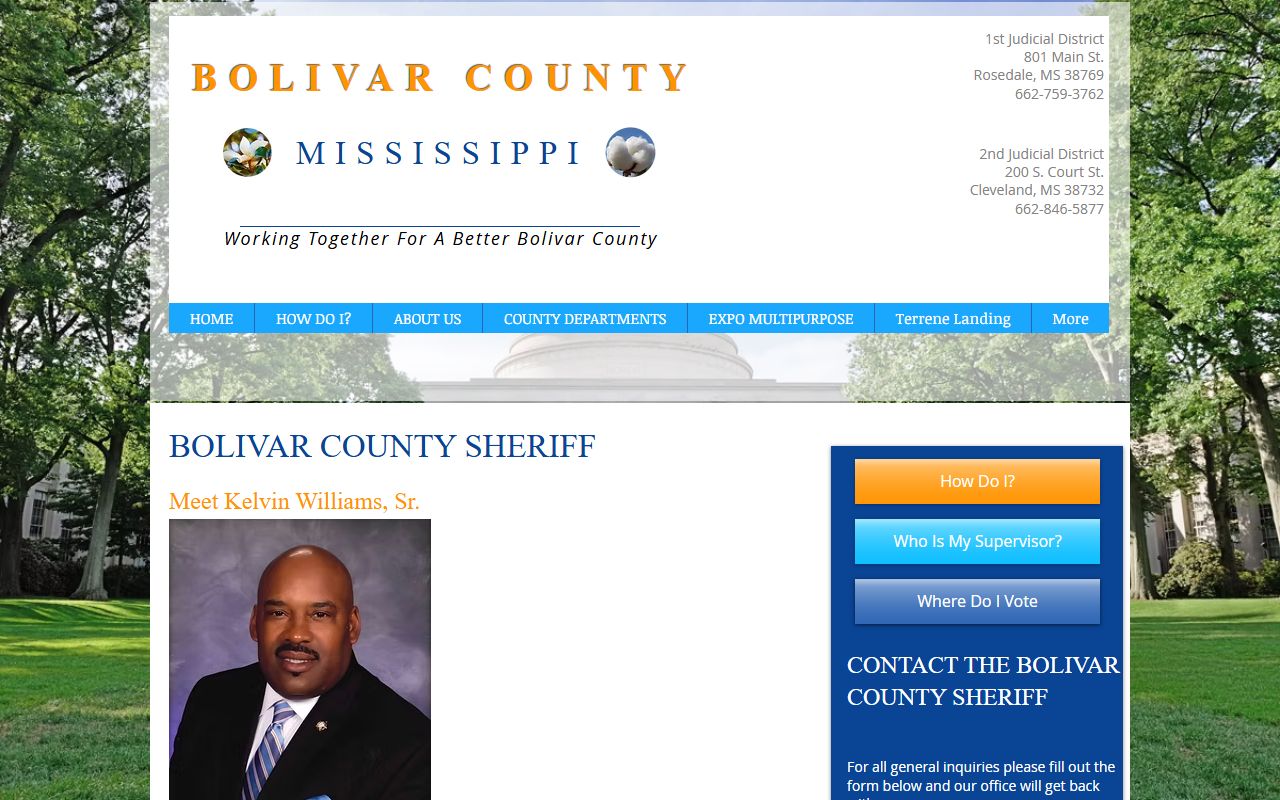
That page is the starting point for confirming the arresting agency before tracing the charges into a court file.
Statewide Charge and Criminal History Lookups
County charges can roll up into statewide records once a case reaches certain stages. When a person is sentenced to state custody, the record moves to the Mississippi Department of Corrections. The MDOC site runs a public search for sentenced inmates and for parolees by first name, last name, or MDOC ID number. That tool tracks state custody, not a recent county booking.
A separate statewide tool is the sex-offender registry, run by the Department of Public Safety. It carries name, geographical, and community-notification search paths after a disclaimer. The MDOC inmate and parolee search and the state registry serve different purposes, and neither is a county jail roster.
The Mississippi sex-offender registry is searched by name, by distance from an address, or by ZIP code.
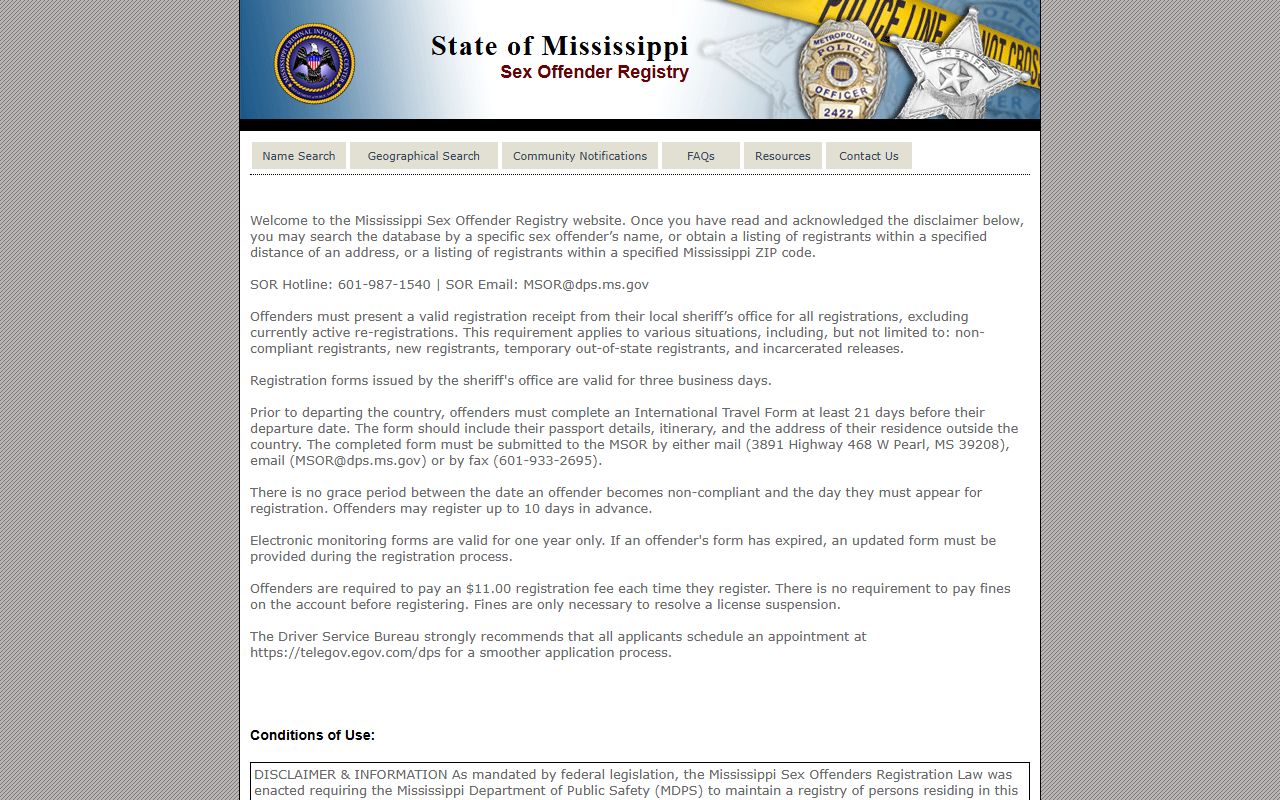
That registry only lists convicted registrants, so it does not reflect an arrest or a charge on its own.
Note: An arrest or a charge for a registrable offense does not require registration unless the case ends in a conviction, and the registry is not a positive form of identification.
Background Check Considerations
A casual lookup of charges is not the same as a formal background check. A casual search pulls public court flags and basic charge data. A formal background check used for hiring, housing, or credit must follow the Fair Credit Reporting Act, which sets accuracy and dispute rules. Charge data without the disposition can be misleading, so a fair report should show how each charge ended.
Important: This site is not a consumer reporting agency under the Fair Credit Reporting Act, and its charge data may not be used for employment, tenant, credit, or insurance decisions.
Restricted Charge Records in Bolivar County
Not every charge is open to the public. Some are confidential by law, and others are hidden by a judge's order. Knowing which charges are restricted saves a wasted trip to the clerk and sets honest expectations for a search.
- Juvenile charges. Youth-court and juvenile law-enforcement records are confidential under Miss. Code Section 43-21-255, since the County Court judge also serves as Youth Court judge.
- Sealed charges. A judge can seal a case, and MEC marks it with a SEALED flag.
- Expunged charges. Once an expungement order applies, the case should not appear as an ordinary public charge.
- Ongoing investigations. Records tied to an open investigation may be withheld until the matter resolves.
- Personal identifiers. Public copies may redact Social Security numbers, financial accounts, and minor information.
For anything that is non-digitized, sealed in status, or older than the online systems reach, a written request to the Circuit Clerk in the correct district is the controlling path. The clerk can confirm whether a charge is open for inspection, sealed, or subject to a court order before any copy is released.